Why One Replacement Wave Creates One Failure Wave
The September 2018 over pressurization event shut off gas service across Lawrence, Andover and North Andover. Thousands of appliances were shut down, and large numbers of water heaters and boilers were replaced or reconnected before service was restored. Aroso Plumbing Lawrence sees the result of that compression every week: instead of a normal spread of installation dates across two decades, a large share of the area's tank heaters share a birthday within a few months of each other.
That matters because water heater failure is not random. It is driven by cumulative hours of hot water, cumulative gallons through the tank, and water chemistry. Put identical equipment into identical housing stock on the same city water supply and start it on the same day, and the wear parts arrive at end of life on roughly the same schedule.
The gas utility serving that system today is Eversource, which took over the former Columbia Gas of Massachusetts territory in the Merrimack Valley. Any gas fitting on these appliances still falls under the Massachusetts Fuel Gas Code and requires a licensed gas fitter and a permit from the City of Lawrence Inspectional Services Department.
What Actually Wears Out Inside the Tank
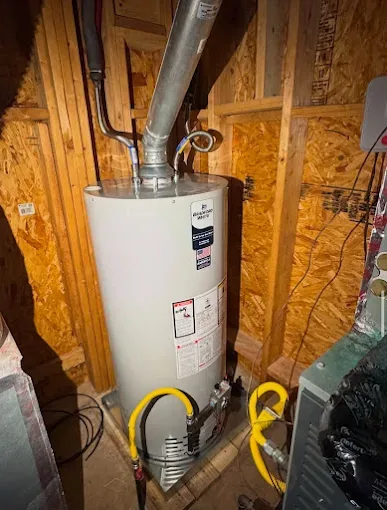
A tank water heater is a steel vessel with a glass lining and a handful of consumable parts. Five things fail, usually in this order.
- Anode rod. A magnesium or aluminum rod that corrodes on purpose so the steel tank does not. Once it is consumed, the tank starts rusting from the inside. On Lawrence water, most rods are substantially gone somewhere between years 4 and 8. A rod pulled at year 6 that is down to bare wire is the single best predictor that the tank has a short remaining life.
- Dip tube. The plastic tube that carries incoming cold water to the bottom of the tank. When it cracks or breaks off near the top, cold water mixes straight into the outlet and you get lukewarm showers with a tank that appears to be working fine.
- Thermostat and gas control valve. The control assembly on the tank side loses calibration or fails outright. Symptoms are wildly swinging temperature, a pilot that will not stay lit, or a burner that short cycles.
- Sediment bed. Hardness and suspended solids drop out and bake onto the tank bottom over the burner. That layer insulates the water from the flame, drives up gas use, and produces the rumbling and popping sound of steam bubbles collapsing under the crust.
- Temperature and pressure relief valve. The T and P relief valve is a safety device set to open at 210 degrees F or 150 psi. Seats corrode, mineral scale builds on the seat, and the valve either weeps continuously or seizes shut.
The thermal expansion tank installed alongside these heaters is on the same clock. Its internal bladder and its air precharge do not last forever, and a waterlogged expansion tank is a common find on units from this era.
How to Tell Where Your Heater Stands
Start with the date. Every manufacturer encodes the build date in the serial number on the rating plate, usually as a letter and digits at the start. If the tank was built in late 2018 or 2019 and is on a Lawrence, Andover or North Andover address, assume it is part of the wave.
Then look for these:
- Rust colored hot water that clears when you run cold. That is tank corrosion, not city water.
- Weeping or dripping from the relief valve discharge pipe. Homeowners and even some contractors replace the valve, the new one weeps within weeks, and the actual cause turns out to be pressure, not the valve. See the section below.
- Rumbling, popping or kettling during a burner cycle. Sediment.
- Hot water that runs out faster than it used to with no change in household use. Broken dip tube or a sediment bed stealing tank volume.
- Moisture, rust staining or a small puddle at the base of the jacket. A wet tank base is not repairable. The tank is done.
- Soot, scorch marks or a lazy yellow burner flame, or a draft hood that spills warm air back into the room. Stop and call. That is a combustion and venting problem.
A pressure test at a laundry sink or hose bibb tells you the rest of the story. Static pressure above roughly 80 psi is out of range under 248 CMR 10.00 and will shorten the life of the heater, the fill valves and the supply lines.
The Relief Valve Weeping Misdiagnosis
This is the most common misread on post 2018 installations. A pressure reducing valve or a backflow preventer at the meter turns the house into a closed system. Water is not compressible. When the burner fires and heats 40 or 50 gallons, that water expands and has nowhere to go, so pressure spikes. It climbs past the 150 psi setting of the T and P relief valve, the valve does exactly what it was designed to do and lifts, and the pressure drops back.
The homeowner sees a dripping valve, buys a new one, and the drip comes back. The real fix is a correctly sized and correctly precharged thermal expansion tank. Replacing a relief valve that is functioning as designed leaves the actual overpressure condition in place.
When It Becomes a Safety or Damage Problem
A leaking tank is a property damage event. In a three decker basement with the heater sitting near a floor drain, you may get away with a wet floor. In a first floor closet or a converted mill loft, 40 gallons on the floor plus continuous supply pressure means finished floors, ceilings below and stored belongings.
The safety issues are narrower and more serious:
- A T and P relief valve that is capped, plugged or has a threaded cap on the discharge is a hazard. That valve is the last defense against a tank rupture. It must discharge downward through full size pipe terminating within 6 inches of the floor, never reduced and never valved.
- Combustion spillage, soot, or a burner that will not stay lit means a venting or draft problem. Carbon monoxide is the risk. Shut the appliance off and get a licensed gas fitter in.
- Any gas odor means leave the building and call Eversource and the fire department before calling anyone else.
For a unit in the 2018 to 2019 window, the practical decision is usually replacement rather than repair once the failure involves the tank itself, the gas control, or a heavily consumed anode. Repair still makes sense for a thermostat, a dip tube, a flush and a fresh anode on a tank with no corrosion signs.
Frequently Asked Questions
How long should a gas water heater last in Lawrence? Roughly 8 to 12 years for a standard atmospheric tank heater. Hard water, high static pressure, an absent or waterlogged expansion tank, and a never replaced anode rod all pull that toward the low end.
Can I just replace the anode rod on a 7 year old tank? Yes, if there are no signs of tank corrosion and the tank is otherwise sound. A fresh anode on a healthy 7 year old tank can add years. If the water already runs rust colored or the base is damp, the anode will not save it.
Do I need a permit to replace a gas water heater? Yes. The gas connection requires a licensed gas fitter working under the Massachusetts Fuel Gas Code, and the permit is pulled through the City of Lawrence Inspectional Services Department with rough and final inspections scheduled. Homeowners cannot pull it themselves.
If your tank is showing any of these signs, our [Water Heater Repair](https://arosoplumbinglawrence.site/services/water-heater-repair) page walks through what we check on site and what usually gets replaced. If yours dates from that window and you want a straight answer on repair versus replacement, Aroso Plumbing Lawrence can look at it.
More guides
[Cast Iron Drain Stacks in Merrimack Valley Three Deckers and How to Tell When One Is Failing
Cast iron drain stacks in three deckers rarely fail all at once. They thin from the inside, weep at …](https://arosoplumbinglawrence.site/blog/cast-iron-drain-stacks-in-merrimack-valley-three-deckers-and-how-to-tell-when-one-is-failing) [Galvanized Supply Pipe: Why Water Pressure Drops in a 100 Year Old House
Galvanized steel supply pipe rusts closed from the inside over 50 to 70 years. The pressure at the s…](https://arosoplumbinglawrence.site/blog/galvanized-supply-pipe-why-water-pressure-drops-in-a-100-year-old-house) [Lead Service Lines in Older Massachusetts Cities and How Replacement Actually Works
A lead service line is the pipe running from the water main in the street to the meter in your basem…](https://arosoplumbinglawrence.site/blog/lead-service-lines-in-older-massachusetts-cities-and-how-replacement-actually-works)