How a Shared Stack Actually Works
The typical Lawrence three decker, built between the 1890s and the 1920s, has a single cast iron stack running floor to roof. Each unit's kitchen and bathroom tie in through branch fittings, usually sanitary tees, at each level. The stack carries waste down to a horizontal building drain in the basement, out through a cleanout, and into one sewer lateral to the street.
Above the highest fixture, the same pipe continues through the roof as the vent stack. That vent is not decoration. It admits air behind draining water so that the falling column does not pull traps dry by siphoning. Every P trap in the building holds a couple of inches of water that block sewer gas. Lose the water seal and you get sewer odor in a unit that has no leak and no clog.
The important consequence of one stack is that the units are hydraulically connected. Everything anyone flushes on three floors goes past the same fittings, and everything downstream of a blockage becomes shared.
Why the Wrong Unit Floods
Water finds the lowest opening. That is the whole mechanism.
Consider a grease and food waste blockage in the horizontal building drain in the basement, downstream of every branch. The third floor runs a dishwasher. Water fills the stack from the blockage upward. It reaches the level of the first branch fitting it can escape from, which is the lowest one: the first floor tub, the basement floor drain, the basement laundry standpipe, or a first floor toilet.
The third floor tenant experiences a slow drain. The first floor tenant experiences three units' worth of dirty water in their bathtub. Neither of them did anything different than usual, and the tenant who reports it is not the tenant whose fixture caused it.
That pattern is diagnostic on its own. Aroso Plumbing Lawrence treats simultaneous symptoms in multiple units as a main line problem until proven otherwise, and single fixture symptoms in one unit as a local branch problem. If a first floor tub gurgles when the second floor toilet flushes, the blockage is below both, not in either.
Venting Problems From a Century of Alterations
Original venting in these buildings was sized for the fixtures that existed in 1910. Almost none of them still have that fixture count.
Common findings on site:
- Wet venting used beyond what it can carry. A wet vent is a drain line that also serves as vent for another fixture, which the code permits within limits. Add a second bathroom off the same line and the vent capacity is gone.
- Fixtures added during unpermitted conversions with no vent at all, relying on the branch to breathe through the stack. Those traps siphon and the units get intermittent sewer odor.
- Air admittance valves installed as a shortcut where a real vent was needed. They fail closed as they age, and their use is restricted under the Massachusetts State Plumbing Code, 248 CMR 10.00.
- S traps left in place from original construction. An S trap siphons itself dry on every use by design. If a fixture smells and drains fine, look under it.
- Kitchen relocated during a remodel, with a long flat trap arm running across a floor bay to reach the stack. Long unvented trap arms hold waste, and grease sets up in them.
- Original 2 inch branches carrying loads that now need 3 inch.
Undersized and compromised venting is the reason a building can be fully clear of blockage and still gurgle, glug and smell. Cabling the line does nothing for a vent problem.
Cast Iron and the Lateral
The stack itself is a wear item at this age. Cast iron scales internally, and that scale is rough, so it catches grease, paper and hair the way a smooth pipe does not. Effective diameter drops. Failure points are predictable: the hub and spigot joints where the oakum and lead packing degrades, and the section at the basement floor line where the pipe rots from the outside in.
Below the building, the sewer lateral may be clay tile or Orangeburg pipe, both common in this housing stock and both vulnerable. Mature street trees put roots into clay joints. Orangeburg, a bituminized fiber pipe, deforms and collapses over time. One lateral serving three kitchens carries triple the grease load of a single family, and grease plus root intrusion is the standard combination behind repeat backups.
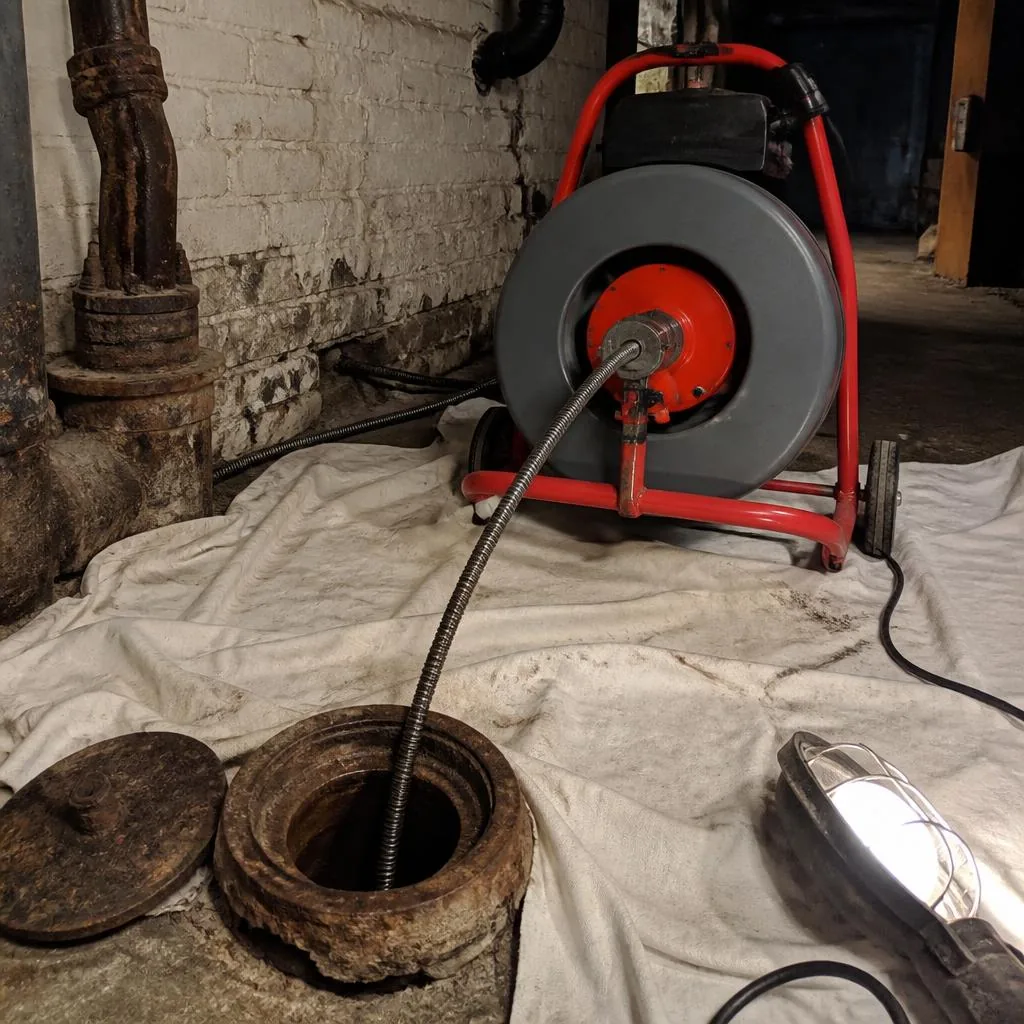
The right diagnostic sequence is a camera inspection through the basement cleanout, not another cabling. A cable clears a hole through a blockage and buys weeks. A camera tells you whether you are looking at accumulated grease, roots at a joint, a bellied section holding water, or a collapse. Grease and scale respond to hydro jetting, which scours the pipe wall back to full diameter. Roots at a broken joint and a collapsed lateral do not respond to anything but repair or replacement.
The Tenant Coordination Problem
Multifamily work is a scheduling problem as much as a plumbing problem, and this is where owners lose money.
Practical constraints:
- Clearing a main line means no water use in any unit while the work is happening. That requires notice to every tenant, not just the one who called.
- Access to the lowest unit is usually required, because that is where the cleanout or the affected fixture is. If that tenant is at work, the job stops.
- Water damage in the first floor unit after an upstairs cause creates a liability conversation between the owner and both tenants. Photograph everything before cleanup starts.
- Jetting a lateral needs a cleanout. Many of these buildings have had theirs paved over, buried behind a finished basement wall, or never had an accessible one installed. Adding a proper cleanout during the first repair prevents the second emergency from becoming an excavation.
- Turnover between tenancies is the only realistic window for stack replacement or venting corrections. Owners who plan that work into a vacancy pay far less than owners who do it around occupied units.
When It Becomes a Property Damage or Health Issue
Sewage in a living unit is a health matter. Contaminated water on carpet, drywall or subfloor requires removal and remediation, not drying, and in wood frame construction it travels into the bay below within hours.
Escalate immediately when:
- Sewage is coming out of a fixture rather than draining slowly. That means the main is blocked and the building has no outlet.
- Multiple units report symptoms at the same time.
- Water is appearing at the basement floor drain during normal upstairs use.
- Sewer odor is persistent in an occupied unit, which indicates dry or siphoned traps and a venting defect, not just a nuisance.
- Any backup recurs within weeks of a cabling. That is a structural pipe condition, and repeated cabling is buying time at increasing cost.
Frequently Asked Questions
Why does my first floor tub back up when the upstairs neighbor showers? Because the blockage is in the shared stack or building drain below both units, and water escapes at the lowest opening. The fixture that backs up is almost never the fixture that caused it.
Who is responsible for a shared stack blockage in a rental building? The shared stack, building drain and lateral are building infrastructure and normally the owner's responsibility, while a blockage confined to one unit's own branch or fixture is handled differently. Determining which one it is takes a camera, not a guess.
Will snaking the line fix a repeat backup? Not usually. Cabling punches an opening through a blockage and restores flow temporarily. If the same line backs up every few months, the cause is grease and scale buildup, root intrusion at a joint, or a failing lateral, and it needs a camera inspection to identify.
Our [Sewer Line Repair and Replacement](https://arosoplumbinglawrence.site/services/sewer-line-repair-and-replacement) page explains how we camera a shared lateral and what the options are when the pipe itself has failed. If a building keeps backing up in the same spot, Aroso Plumbing Lawrence can put a camera on it and tell you what is actually down there.
More guides
[Cast Iron Drain Stacks in Merrimack Valley Three Deckers and How to Tell When One Is Failing
Cast iron drain stacks in three deckers rarely fail all at once. They thin from the inside, weep at …](https://arosoplumbinglawrence.site/blog/cast-iron-drain-stacks-in-merrimack-valley-three-deckers-and-how-to-tell-when-one-is-failing) [Galvanized Supply Pipe: Why Water Pressure Drops in a 100 Year Old House
Galvanized steel supply pipe rusts closed from the inside over 50 to 70 years. The pressure at the s…](https://arosoplumbinglawrence.site/blog/galvanized-supply-pipe-why-water-pressure-drops-in-a-100-year-old-house) [Lead Service Lines in Older Massachusetts Cities and How Replacement Actually Works
A lead service line is the pipe running from the water main in the street to the meter in your basem…](https://arosoplumbinglawrence.site/blog/lead-service-lines-in-older-massachusetts-cities-and-how-replacement-actually-works)