Two Separate Pipes, Two Separate Rules
Every building has two buried pipes doing opposite jobs. The water service line brings pressurized potable water in, typically 3/4 inch or 1 inch, from the main under the street to the main shutoff inside the basement wall. The sewer lateral carries waste out by gravity, usually 4 inch or 6 inch, sloped at roughly 1/4 inch per foot toward the sewer main.
They fail differently. A service line leak sits under 40 to 80 psi and pushes water outward until something surfaces or the meter spins with every fixture closed. A lateral is a gravity system that simply stops moving, so the first symptom is backup, not water loss.
Where the Ownership Line Actually Falls
Three fittings define the boundary, and knowing their names makes any conversation with the water department shorter.
- The corporation stop is the valve at the water main where your service line taps into the city pipe. It is the physical start of your line.
- The curb stop sits in the tree belt or sidewalk under a small round cast iron cover, sometimes called the curb box or shutoff box. It is the only valve between the main and your house that can be operated from outside.
- The water meter, just inside the basement wall, is city property in most systems even though it sits in your building.
The common misunderstanding: the curb stop is a shutoff, not a property line. It exists so the utility can isolate a house without entering it. In Lawrence and across the Merrimack Valley, the owner is generally responsible for the service line from the corporation stop in, which means a leak in the middle of the street is still yours to fix and yours to permit.
The sewer side has an even less forgiving split. The city maintains the sewer main in the street and, if the system serves a combined main, whatever is in it. The lateral, from the building drain out to the wye connection at the main, belongs to the property. There is no curb stop equivalent. There is only the cleanout, and many older Lawrence properties do not have one outside.
Why an Exterior Cleanout Matters More Than People Think
A cleanout is a capped access point that lets a cable machine or jetter hose enter the lateral in line with the flow. On housing built between 1890 and 1920, the only access is often a plug on the cast iron house trap in the basement floor, or worse, nothing at all, and the line has to be worked through a pulled toilet.
An exterior cleanout near the foundation changes several things at once:
- A blockage can be cleared without dragging equipment and waste water through a finished basement or through a tenant's apartment.
- It gives a clean shot for camera inspection, so the pipe can be filmed from the house toward the main with a locating transmitter in the camera head marking depth and position on the surface.
- It marks the boundary. Debris and standing water at the cleanout tell you the problem is downstream in the lateral. A dry cleanout with a backing up basement fixture points upstream, inside the building.
- In a three decker with a single lateral serving three kitchens, it is the only practical way to clear a shared line without shutting off drainage for every unit.
Installing one means digging to the lateral, cutting in a wye and a riser to grade, and capping it. It is a small excavation, and it pays for itself the first time a line backs up on a holiday.
How to Tell Which Pipe Is Failing
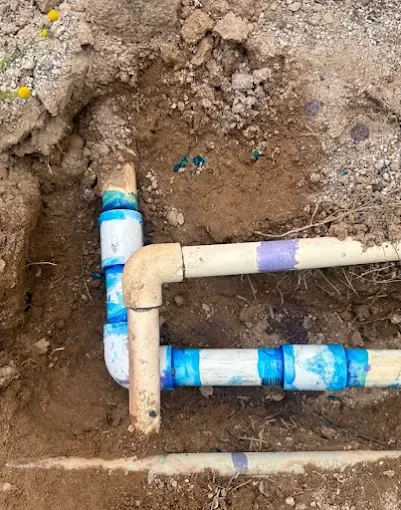
For a suspected service line leak, shut every fixture, close the main shutoff at the house, and watch the meter's low flow indicator. If it still creeps with the house valve closed, the leak is between the main and that valve, which means it is underground. If it stops, the leak is inside. Wet or unusually green ground over the service line run, a drop in static pressure at an outside hose bibb, or the sound of running water at the meter with nothing on all point the same way. On older properties, expect to find galvanized steel or a lead service line, both of which the city and MassDEP are working to identify and replace, and both of which change the repair plan.
For the sewer lateral, the sequence is: pull the cleanout cap, run a cable to establish whether the line opens at all, then camera the pipe. The camera tells you what a cable never will. Standing water partway down means a belly or a sag. Fine roots at a regular interval mean joint intrusion. An oval cross section means Orangeburg. Offset joints, a crushed section, or open ground visible through the pipe wall mean replacement, not cleaning.
When It Becomes a Property Damage or Safety Problem
- Sewage backing up through a basement floor drain or a first floor shower. That is contaminated water in living space, and the cleanup, not the pipe, is the expensive part.
- A collapsed lateral under a driveway or sidewalk, where the void above the break eventually shows as a depression or a sinkhole.
- A service line leak washing out fill under a foundation or a slab.
- Any water service repair in a street, which involves excavation, traffic control, and a permit through the City of Lawrence Inspectional Services Department, and is not homeowner work under 248 CMR 10.00.
Insurance treats these differently too. Many policies cover the water damage from a backup only with a specific endorsement, and almost none cover the buried pipe itself. Some municipalities offer optional service line coverage through the water bill. Check before you need it.
The practical move for an older property: get the lateral filmed once, before there is a problem, and have the footage and the surface locate on file. Knowing you have 60 feet of clay with root intrusion at 34 feet is a plan. Finding out at 11 pm on a Sunday is an emergency.
Frequently Asked Questions
Does the city fix my sewer line if the break is under the street? No, in most cases the property owner is responsible for the entire lateral including the portion under the public way. The city's responsibility begins at the sewer main. You will need a permit and, usually, a street opening permit to dig in the roadway.
Who is responsible for the curb stop? The water department typically owns and operates the curb stop, but the pipe on both sides of it belongs to the property owner. If the curb stop is buried, seized, or missing its box, ask the water department to locate and service it rather than digging it up yourself.
How long does a sewer lateral last? It depends entirely on material. Cast iron and clay commonly reach 60 to 100 years, Orangeburg often fails at 30 to 50, and modern PVC should outlast the building. Root pressure, soil movement, and heavy vehicle loading over shallow pipe all shorten those numbers.
If a camera inspection shows a broken, offset, or collapsed lateral, our [Sewer Line Repair and Replacement](https://arosoplumbinglawrence.site/services/sewer-line-repair-and-replacement) service covers locating the failure, permitting the dig, and restoring the line.
More guides
[Cast Iron Drain Stacks in Merrimack Valley Three Deckers and How to Tell When One Is Failing
Cast iron drain stacks in three deckers rarely fail all at once. They thin from the inside, weep at …](https://arosoplumbinglawrence.site/blog/cast-iron-drain-stacks-in-merrimack-valley-three-deckers-and-how-to-tell-when-one-is-failing) [Galvanized Supply Pipe: Why Water Pressure Drops in a 100 Year Old House
Galvanized steel supply pipe rusts closed from the inside over 50 to 70 years. The pressure at the s…](https://arosoplumbinglawrence.site/blog/galvanized-supply-pipe-why-water-pressure-drops-in-a-100-year-old-house) [Lead Service Lines in Older Massachusetts Cities and How Replacement Actually Works
A lead service line is the pipe running from the water main in the street to the meter in your basem…](https://arosoplumbinglawrence.site/blog/lead-service-lines-in-older-massachusetts-cities-and-how-replacement-actually-works)