
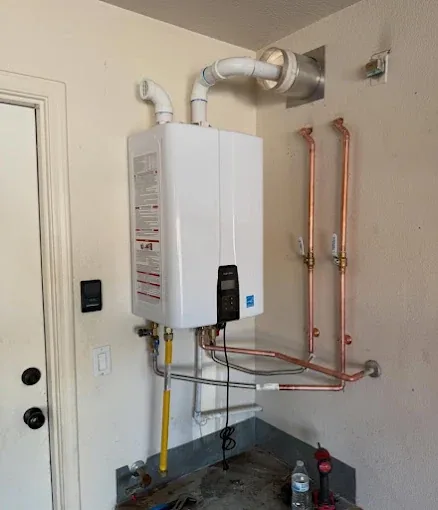
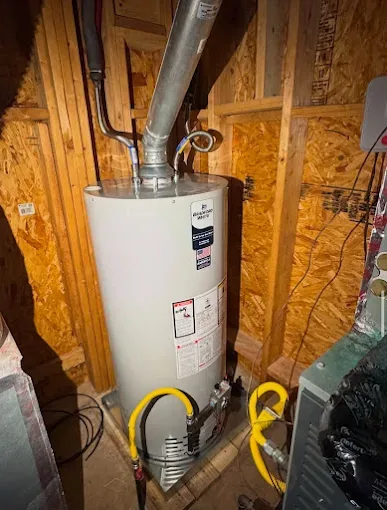
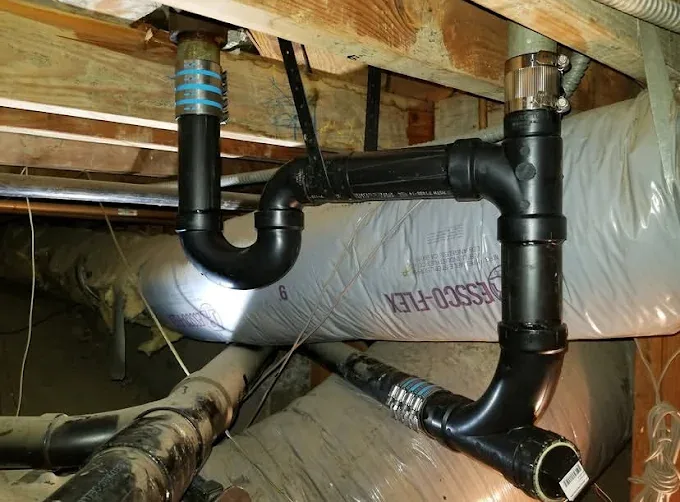
Diagnosis on a water heater is a short list worked in order. We check whether the unit is getting energy before we touch anything inside it: gas at the valve and a proven ignition sequence on a gas unit, voltage and continuity at both elements and thermostats on an electric one, and boiler side flow and aquastat function on an indirect fired tank. Then we check whether it can move heat into the water. Sediment on the bottom of a gas tank insulates the burner from the water, a collapsed dip tube sends cold water straight to the outlet, and a failed mixing valve blends the hot away before it reaches the fixture. We measure the actual delivered temperature at a nearby faucet and static pressure on the cold side, because a pressure problem gets reported as a hot water problem more often than you would think. Age, capacity, recovery rate and the number of fixtures the tank serves all get factored in before we recommend repair over replacement.
Lawrence has a water heater age problem that is specific to this city. After the September 2018 Merrimack Valley over pressurization event, thousands of gas appliances across Lawrence, Andover and North Andover were shut off, replaced or reconnected inside a very short window. That means a large share of the city's water heaters were installed within months of each other and are now aging out together. Anode rods, thermostats, gas control valves, expansion tanks and temperature and pressure relief valves are hitting end of life in the same buildings at the same time. On top of that, Lawrence draws its water from the Merrimack River through the Lawrence Water and Sewer Department, and winter inlet temperature runs cold. Cold inlet water means longer recovery on a tank and, on a tankless unit, a real drop in usable flow rate, because the burner has to lift incoming water a much larger number of degrees to reach setpoint. Steam and hot water boilers are everywhere in the older housing stock, so indirect fired tanks and tankless coils show up constantly, and a three decker with one heater feeding three apartments is a sizing problem before it is a repair problem.
Water heater replacement is permitted work in Massachusetts, filed with the City of Lawrence Inspectional Services Department and inspected. The Massachusetts State Plumbing Code, 248 CMR 10.00, governs the plumbing side: the temperature and pressure relief valve and its full size discharge pipe terminating properly, expansion control, shutoff valve placement, dielectric separation between dissimilar metals, and seismic and support requirements. Gas is a separate matter. Gas fitting in Massachusetts requires its own license from the Massachusetts Board of State Examiners of Plumbers and Gas Fitters under the Massachusetts Fuel Gas Code, and a gas water heater installation involves both trades, with the gas permit and the plumbing permit both pulled. Venting is inspected as part of that. The other piece the code forces is thermal expansion control. Many Lawrence services now have a pressure reducing valve or a check valve at the meter, which makes the system closed, and a closed system without a properly sized and correctly charged expansion tank will lift the relief valve every heating cycle.
The judgment calls are where experience shows. A relief valve dripping is almost never a bad relief valve, it is thermal expansion on a closed system, and replacing the valve without adding or recharging an expansion tank just buys a few months. Expansion tanks fail silently: the bladder ruptures, the tank fills with water and does nothing, and the giveaway is a tank that feels heavy and sounds dead when you tap the bottom. On the venting side, swapping an old atmospheric unit for a high efficiency one is where jobs go wrong. An 80 percent gas water heater commonly shares a masonry chimney with a boiler, and if you take that water heater out and install a direct vent or power vent unit, the boiler is now orphaned in an oversized flue, which condenses, deteriorates the liner and can spill combustion products. That chimney has to be relined or the boiler venting reworked, and it is not optional. On tankless, hard scale in Lawrence builds on the heat exchanger and shows up as fluctuating temperature and error codes rather than no hot water, and a unit sized on summer inlet temperature will disappoint the same household in February. On electric tanks, a heater that produces some hot water that runs out fast is usually a failed lower element, while no hot water at all is usually the upper thermostat or a tripped high limit, and resetting that high limit without finding why it tripped sends us back out in a week.
Technician insight
Before I open a panel I run the hot at the closest fixture and watch a thermometer for two minutes, because half the no hot water calls I take in this city are really a tempering valve or a long uninsulated run through a cold basement, not the heater. On indirect fired tanks the tell is different: if the tank is cool but the boiler is hot, I go straight to the zone valve or the circulator for that zone rather than blaming the tank. And when a tank feeds three apartments in a three decker, I ask what time of day the hot water runs out, because a recovery problem and a capacity problem look identical to the tenant and need completely different fixes.
Hot water running out early in a converted two family
The upstairs unit of a converted two family reported hot water lasting only a few minutes each morning while the downstairs unit had no complaints. The single gas tank in the basement was serving both kitchens and both baths off one 40 gallon unit with a long uninsulated run to the second floor. The burner fired and the flue drafted fine, but the tank bottom was heavily sedimented and the recovery rate was well below what two households drawing at the same hour needed. We flushed the tank, replaced a spent anode rod and then laid out the honest options: insulate the run and stagger usage, or size a replacement on the actual fixture count rather than on the label of the unit that was there.
Water Heater Repair Services We Offer
Tank Water Heater Repair
Diagnosis and repair of gas and electric storage tanks, covering gas control valves, thermocouples and igniters, elements, thermostats, dip tubes and draft problems. We tell you honestly when a tank is past the point where repair makes sense.
Water Heater Replacement and Installation
Removal and replacement of failed tanks with a correctly sized unit, including new shutoff, dielectric connections, relief valve discharge, expansion control and code compliant venting. Permitted through City of Lawrence Inspectional Services.
Tankless Repair and Descaling
Repair of on demand units including flow sensors, igniters, flame rods and error code diagnosis, plus circulation descaling of the heat exchanger through the isolation valves. Recommended annually given Lawrence water and cold winter inlet temperatures.
Indirect Fired and Tankless Coil Work
Service for hot water made by the boiler, common throughout Lawrence three deckers and Victorians. Covers indirect tank aquastats, zone valves and circulators, and tankless coil flow, scaling and mixing valve problems.
Thermostat and Element Replacement
Testing and replacing upper and lower thermostats, heating elements and high limit switches on electric water heaters, including finding the underlying fault that tripped the limit rather than just resetting it.
Anode Rod and Sediment Flush
Inspection and replacement of the sacrificial anode rod that keeps the tank lining from corroding, and full sediment flush of the tank bottom. Both are the difference between a tank lasting 8 years and 15.
Temperature and Pressure Relief Valve and Expansion Tank
Replacement of failed or weeping relief valves with correct discharge piping, and installation, testing or recharging of thermal expansion tanks on closed systems with a pressure reducing valve at the meter.
How it works
Confirm energy in, heat out
We verify gas supply and ignition, or voltage at both elements and thermostats, or boiler side heat on an indirect tank, before opening anything up.
Test the system around the heater
Delivered temperature at a fixture, static pressure, expansion tank charge, relief valve condition and mixing valve function often explain a complaint the heater itself is not causing.
Repair or size a replacement
If the tank is sound we repair it. If it is not, we size the replacement on real demand, fixture count, recovery rate and winter inlet temperature, not just on matching the old label.
Vent, permit and verify
Venting is corrected for the unit actually installed, permits are filed with City of Lawrence Inspectional Services, and we verify draft, temperature and expansion control before leaving.
Pricing
Repairs and replacements price very differently, so we separate them before you decide. A thermostat, element, thermocouple, anode rod or relief valve is a parts and labor repair, commonly in the 200 to 500 range depending on the part and how buried the unit is. A tankless descaling sits in a similar band and takes 1 to 2 hours. Replacement is a bigger number, and what moves it is capacity, fuel type and venting. An electric tank swapped one for one in an open basement is the low end. A gas unit costs more because it involves both plumbing and gas fitting, both permits, and combustion venting. The number climbs further when the old unit was atmospheric and the new one is power vent or direct vent, since new venting has to be run and an orphaned boiler in the shared chimney has to be addressed. Tankless installation is the highest, because it usually needs a larger gas line, dedicated venting and isolation valves. Indirect fired tanks add boiler side piping and controls. Aroso Plumbing Lawrence quotes the whole scope, venting and permits included, so the price does not change halfway through.
Water Heater Repair — FAQs